
- Material:
- Granite
- Category:
- Plutonic, Igneous
- Colour:
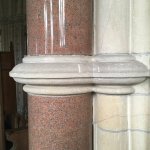
- Pinkish Grey
- Colour variation:
- Uniform
- Grain/Crystal Size:
- Coarse
- Place of origin:
- Scotland
- Rock Unit Name:
- Geological Age:
- Devonian
Part of:
Notes:
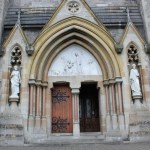
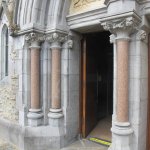
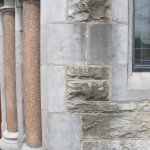
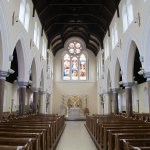
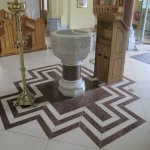
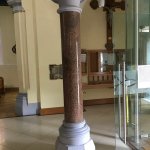
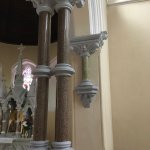
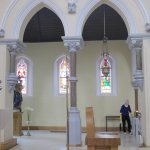
The Aberdeen granite industry developed in the 18th century and continued to expand throughout the 19th century until Aberdeen became known as a world-renowned producer of granite. There were many granite quarries in Aberdeenshire, producing stone of varying colour and texture and exploited for a wide variety of uses. Peterhead Red Granite is a durable, pink-coloured, biotite-rich, coarse grained building stone that originated from from the Peterhead Granite Pluton, which formed during the later part of the Silurian Period (c. 425 million years ago). The Peterhead granite was sourced from Boddam, near Peterhead, Scotland where it was extensively quarried in the 18th and 19th Centuries. It has been widely used in the local area and abroad for decorative and monumental work, e.g. polished columns in St John's College Chapel, Cambridge, and St George's Hall, Liverpool, and many Victorian churches throughout Ireland. The first reported use of the stone in Dublin was in 1860 where polished columns and pilasters were used in a doorway portico at 2 Merrion Square East (The Dublin Builder, 1st February 1860, p. 203). In 1859 in Belfast the Ulster Bank at Waring Street contined four columns 28 feet high of Aberdeen Granite (colour not specified in The Dublin Builder 1st October 1859, p. 134). The quarry closed in 1956.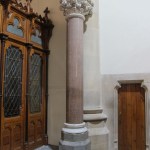








References
4358386
peterhead_red_granite
1
apa-annotated-bibliography
50
default
4753
https://stonebuiltireland.com/wp-content/plugins/zotpress/