
- Material:
- Conglomerate
- Category:
- Siliciclastic, Sedimentary
- Alternative name(s):
- Victoria Red, Park Red, Cork Marble, Cork Red Conglomerate
- Colour:
- Red, White
- Colour variation:
- Variegated, Mottled, Veined, Stylolitic
- Grain/Crystal Size:
- Coarse
- Place of origin:
- Cork, Ireland
- Rock Unit Name:
- Cork Red Marble Formation
- Geological Age:
- Carboniferous, Dinantian, Chadian
- Fossils:
- brachiopods, bryozoans, crinoids, foraminifera
- GSI Rock Unit Code:
- CK
- GSI Rock Unit Summary:
- Cream, pink and red calcilutite limestones and pseudo-breccias in a red mudstone matrix.
- Context of Use:
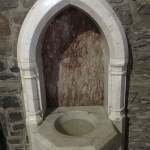
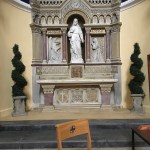
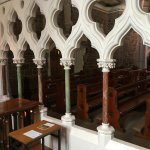
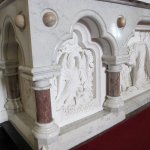
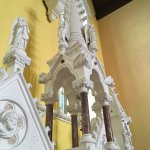
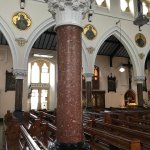
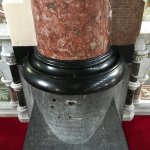
- Mainly decorative as polished stone in architectural elements (usually internal). Also used in headstones and as a minor building stone and paving stone in the local area.
Notes:
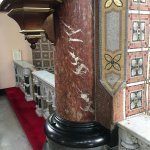
A lime conglomerate that contains rounded white blotches representing the original calcite pebbles, surrounded and supported in a red clay-rich matrix. This rock type was deposited during the earliest part of the Carboniferous 350 Ma ago in a shallow water marine environment quite close to the shoreline. The dominant red colouration results from haematite, an iron-oxide which was derived from the erosion of the red sandstones that underlie the Carboniferous succession. Following lithification, the rock underwent some slight deformation due to compression caused during the Hercynian Orogeny towards the end of the Carboniferous. This produced stylolites due to dissolution with concentration of red clay in wavy bands that cross-cut some of the pebbles. Calcite veins also cut the stone fabric and the stylolites. This limestone is sparsely fossiliferous with crinoids visible as circular traverse sections as well as longitudinal sections of crinoids stems in both the matrix and the calcite pebbles in hand sample, and fragmentary brachiopods, bryozoans and foraminiferans in thin section.






References
4358386
cork_red_marble
1
apa-annotated-bibliography
50
default
4753
https://stonebuiltireland.com/wp-content/plugins/zotpress/