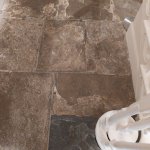
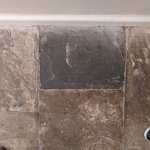
- Material:
- Sandstone
- Category:
- Siliciclastic, Sedimentary
- Alternative name(s):
- Mountmellick Flags
- Colour:
- Yellow
- Colour variation:
- Whiteish green
- Grain/Crystal Size:
- Fine
- Place of origin:
- Laois, Ireland
- Rock Unit Name:
- Clonaslee Member (Cadamstown Formation)
- Geological Age:
- Devonian, Upper Devonian
- GSI Rock Unit Code:
- CWcl
- Context of Use:
- Flagging for flooring
- Related Material (same rock unit):
- Clonaslee (Rosenallis) Sandstone, Srahcullen (Clonaslee) Flagstone
Notes:
A fine grained yellowish or whiteish-green sandstone raised since the mid-1700s in various quarries situated close to Clonaslee and Rosenalis. They were marketed through Mountmellick 10 miles to the east and hence their trade name. They were popularly used in Dublin in the 1700s but later in the 1800s Carlow Flagstones became the dominant flagging material.
Examples of their use in Dublin and Wicklow are documented in early building accounts for Powerscourt House, Enniskerry, Co. Wicklow (Hayes 2023, p. 173) and for the Provost's House, Trinity College Dublin (Hand 2010, p. 89) where the stone in the corridor leading to the house from the entrance on Parliament Square is flagged in the stone. The paving under the portico of the Parliament House (later Bank of Ireland) on College Green was replaced with granite pavers, while the inner hallway of 15 St Stephen's Green has Mountmellick Flags together with some black Carlow flagstone repairs. The entrance hall and the patients rooms of Jonathan Swift's St Patrick's Hospital in Dublin are floored with the stone (Craig 1948, p. 34).
Wilkinson (1845) lists two in the Tables of Experiments but notes (p. 237) that flags of large size cannot be procured from these places. The quarries ‘are not worked to any great extent, but they require much dressing, and are therefore expensive.’ (p. 236). Clara Hill, at Clonaslee and Rosenalis Mountains (2kn east of Clonaslee) produced yellowish, with ocherish spots, micaceous, and rather fine grained, very siliceous, while the quarry at Ballinalug (Ballynalug) Mountain, Tinnahinch Bridge, 2 miles from Clonaslee the stone was greenish white, chiefly siliceous grains, with argillaceous cement, and disseminated particles of carbonaceous matter. When first raised the flags were soft, but rapidly hardened (Kinahan 1889, p. 293). Other quarries were located at Glenbarrow, 3 miles from Clonaslee that yielded a grey stone with iron spots, the Mill Quarter Quarries near Tinnahinch Bridge, the Srahcullen Quarry and currently active quarries in Glebe and Ross Townlands.
Flags at the quarry in 1779 cost 3s 6d to 4s per square yard (Hodgson 1779, p. 15); in 1801, squared and laid: 5s 6d per square yard (Hodgson 1801, p. 100); in 1815, squared and laid: 6s per square yard (Hodgson (1815, p. 110); 10 to 13d per yard, and in 1845 for preparing flags about 6d per yard, or if chiselled on face about 1s 2d to 1s 3d per yard (Wilkinson 1845, p. 237). The Srahcullen quarry owner Michael Troy delivered flags to Tullamore for 4s per square yard. Steps with a chiselled surface are 2s 6d per superficial foot. Gate posts are 25s to 30s a pair. These are known as Clonaslee Flags (GSI Memoir 1866, p. 13). In the 1700s and early 1800s the price of Mountmellick flags were more than Palmerstown Stone quarried at the Cursis Stream Quarry but less than Carlow Flags from Shankill and Kellymount, Co. Kilkenny (see Hodgson).