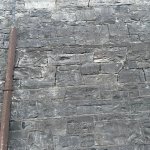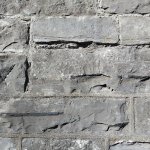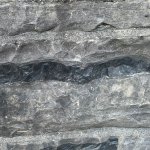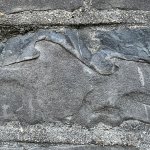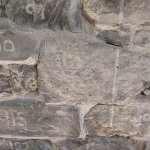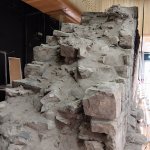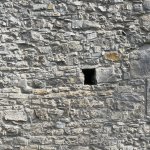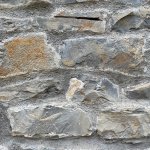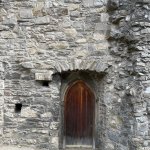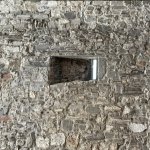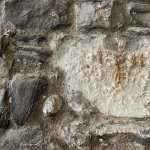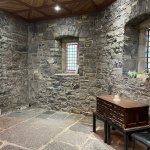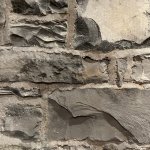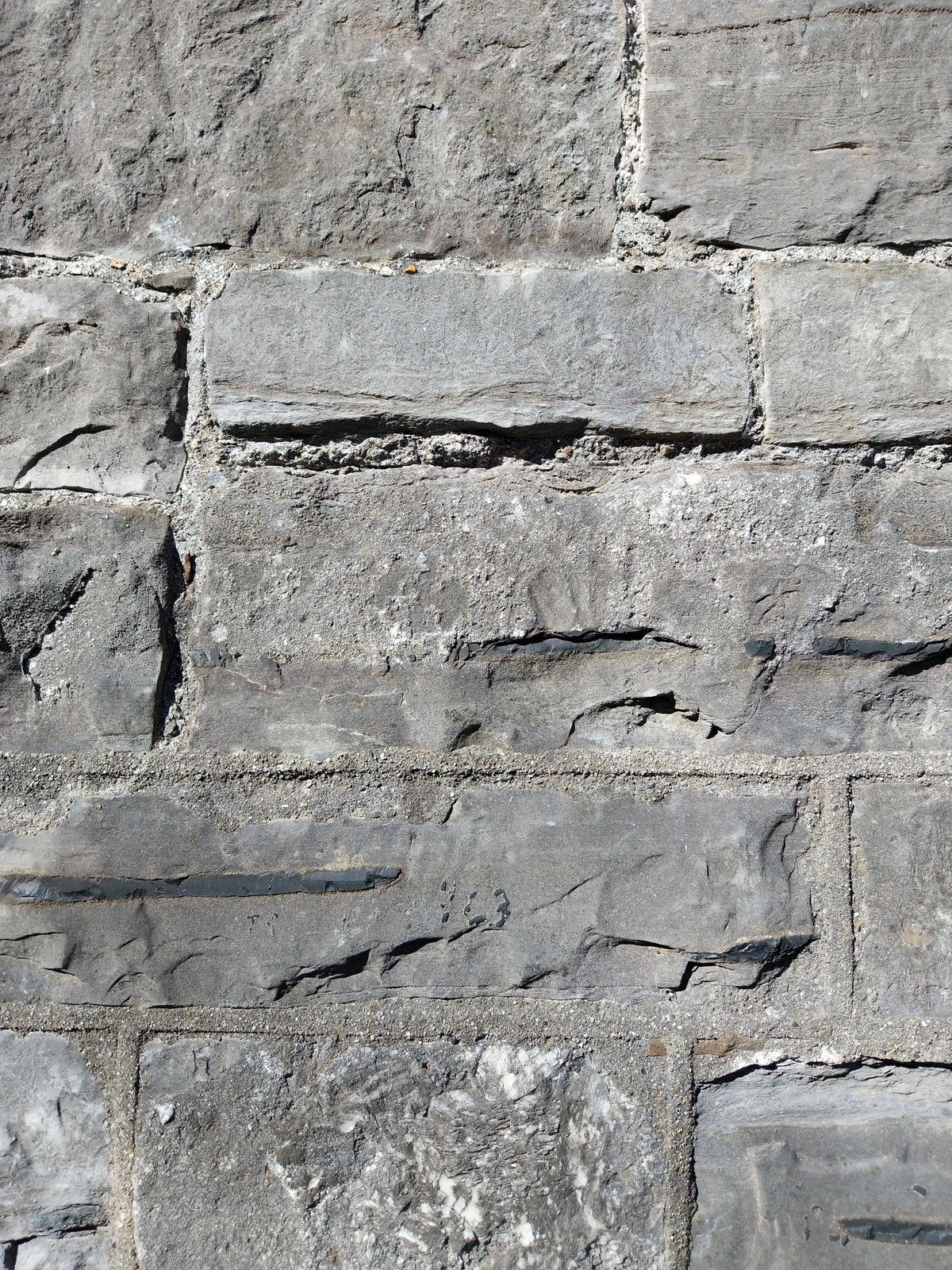
- Material:
- Limestone
- Category:
- Carbonate, Sedimentary
- Colour:
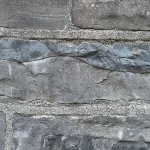
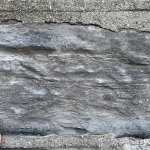
- Dark Grey to Black
- Colour variation:
- Uniform
- Grain/Crystal Size:
- Fine
- Place of origin:
- Dublin, Ireland
- Rock Unit Name:
- Lucan Formation
- Geological Age:
- Carboniferous, Dinantian, Late Chadian-Asbian
- Fossils:
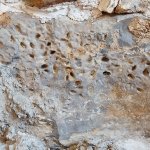
- brachiopods, bryozoans, foraminifera, sponge spicules
- GSI Rock Unit Code:
- LU
- Context of Use:
- Building
Part of:
- Related Material (same rock unit):
- Crossdrum Limestone, Cullion Limestone, Donaghcumper Limestone, Drumelis Limestone, Dunsany Limestone, Enfield Limestone, Fulmort Limestone, Lisbunny Limestone, The Heath Limestone, Trim Limestone
Notes:
Nearly all the limestone in Dublin is of the Calp type and varies greatly in character. It is extracted from the Lucan Formation, which ranges in thickness from 300 to 800 m and consists of dark coloured, argillaceous, cherty, spicular micrites and shales, with horizons of graded, skeletal limestones, containing ooids and other shallow water grains. It accumulated in relatively deep water as hemipelagic mud and silt and distal turbidites (Sevastopulo and Wyse Jackson 2001, 2009).
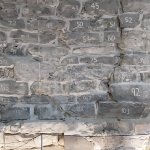
Dublin is characterised by the use of Calp limestone, alongside Leinster granite and Portland stone, in its buildings, reflecting the abundance of local quarries in the region throughout the eighteenth and into the nineteenth centuries (Wyse Jackson and Caulfield 2025). The colour of the stone ranges from light grey to dark blue-black, or almost black, though it tends to bleach to a lighter shade when exposed. In general, it was only suitable for rubble work, and occasionally for ashlar work, but as it could be extracted in large sizes, it was also valuable for foundations (Wilkinson 1845; Kinahan 1889). Many of Dublin’s public buildings were constructed with insufficient regard for the quality of the Calp, and without adequate care in selecting and using the soundest quarry beds. As a result, the stone was prone to becoming laminated clay and deteriorating rapidly when exposed to the elements. Some quarries contained stone that produced good-quality lime when burnt, while others had few, if any, beds suitable for the purpose (Wilkinson 1845). In 1845, Wilkinson documented that Calp limestone, extracted from Dublin quarries, was delivered at from 2s. 6d. to 3s. per ton. Likewise, he documented that lime from Dublin Calp quarries was delivered at 9d. per hogshead (traditional large wooden cask that usually held 230 to 530 liters).