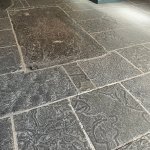
- Material:
- Sandstone
- Category:
- Siliciclastic, Sedimentary
- Alternative name(s):
- Liscannor Flag, Shamrock Stone
- Colour:
- Dark Grey to Black
- Colour variation:
- Uniform
- Grain/Crystal Size:
- Medium
- Place of origin:
- Clare, Ireland
- Rock Unit Name:
- Central Clare Group
- Geological Age:
- Carboniferous, Namurian
- Fossils:
- ichnofossils
- GSI Rock Unit Code:
- CCG
- Context of Use:
- Flagstone, setts, building shoddies, kerbs, channels, steps, landings.
- Related Material (same rock unit):
- Money Point Flagstone
Notes:
Micaceous, medium-grained sandstone, frequently with Olivellites traces - these form meandering patterns horizontal to bedding. Some parts of the succession contains vertical burrows.
The stone was marketed as 'Shamrock Stone' by United Stone Firms Ltd. between 1909 and 1917, who operated the quarries at Doonagore, Caherbarnegh and Luogh South. They described the self faced flags, which did not wear slippery, as 'unquestionably the very best natural Stone Flags produced anywhere'. All sizes of kerb and channel were obtainable. Setts and building shoddies were also supplied and worked in large quantities. The block beds were sawn into steps, landings and other articles for general building purposes. Some British sites that contain Liscannor stone include the steps and landings at the main entrance to St John's Gardens, Liverpool; paving on Shrewsbury Road and Devonshire Road, Birkenhead; and paving, kerbs and channels in streets at Penylan, Roath, Cardiff.
- Chemical analysis by United Stone Firms Ltd.: